Bumkins Waterproof Bibs Overview
Bumkins is a useful brand to shortlist if you are trying to make mealtimes less chaotic, but the sensible way to assess its waterproof bibs is format by format. A bib that works well for a quick snack may not be the one you want for a messy, self-fed lunch; a sleeved option, a standard fabric-style bib and a silicone bib invite different compromises around coverage, cleaning and storage.
The evidence available for this guide is deliberately narrow. The supplied official Bumkins page is a silicone-products collection rather than a detailed waterproof-bib catalogue. It is helpful for understanding that the brand has a wider feeding assortment, but it does not prove specifications, current availability or performance for every bib style. Separately, BabyGearLab’s 2013 review discusses the Bumkins SuperBib specifically, rather than the whole waterproof-bib range.
That means this is not a hands-on test or a blanket verdict on every Bumkins bib. Instead, use it as a practical shortlist: decide what sort of coverage and clean-up routine your household needs, then check the live merchant listing for the exact bib’s materials, fastening, care instructions, dimensions, age guidance and delivery terms.
If you are planning your first feeding setup, our Baby Weaning Essentials Guide can help you distinguish genuinely useful everyday kit from extras that can wait.
How to Compare the Bumkins Bib Formats
AI-generated generic editorial illustration — not a retailer product photo and does not depict the reviewed product or service. Give readers a neutral visual framework for comparing bib formats without presenting unsupported range-wide performance claims.
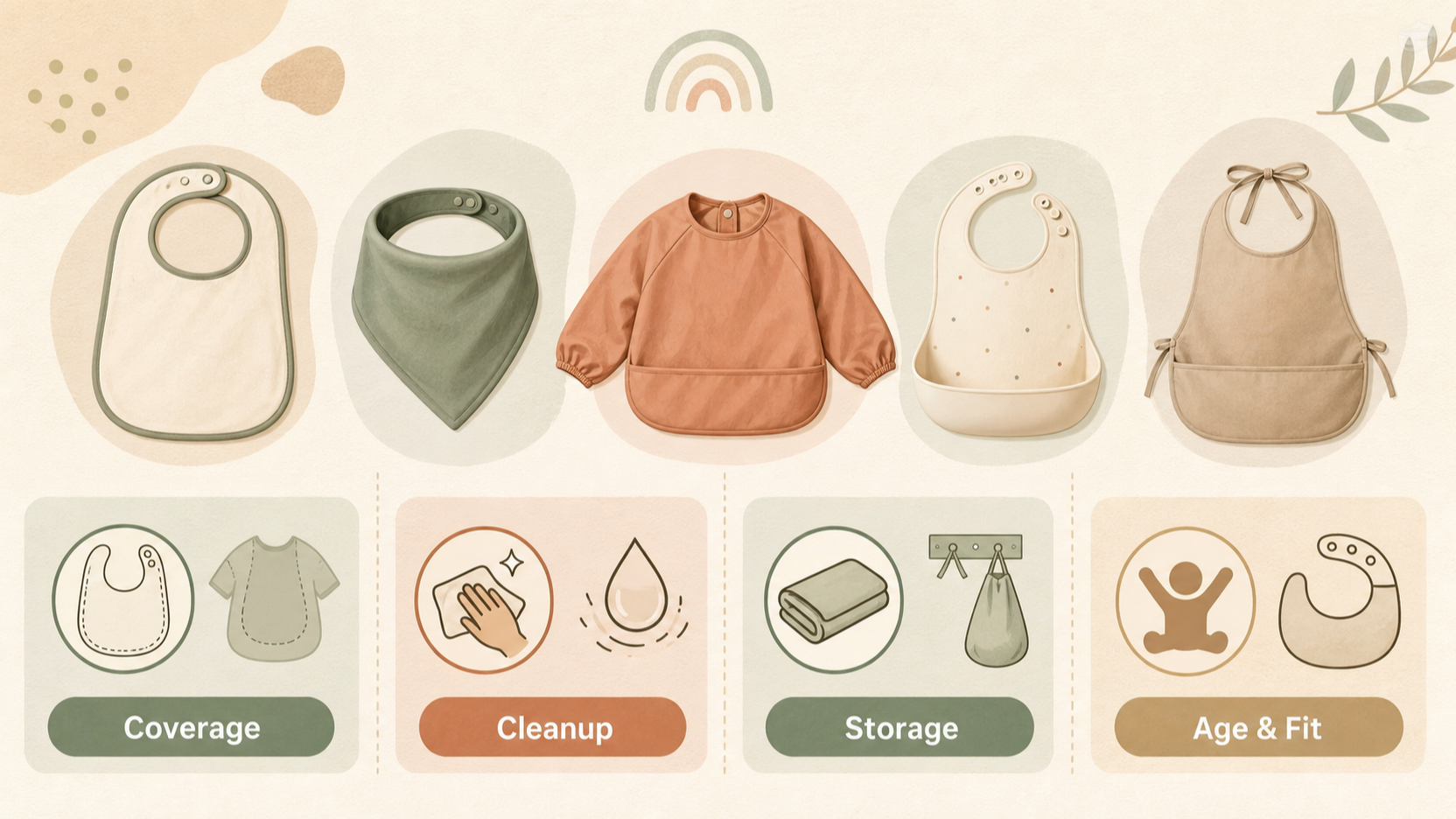 Before choosing between a Starter Bib, SuperBib, Sleeved Bib or Silicone Bib, begin with the mess you are actually trying to manage. The labels describe different formats, but a product name alone cannot tell you whether it will suit your child, chair setup or laundry routine. Compare the current listings against the same practical questions.
First, think about coverage. For spoon-feeding, milk dribbles or small snacks, you may prefer a lighter, less enclosing bib. For finger food, sauce, yoghurt or meals where a child is practising independence, decide whether you need coverage across the torso only or want sleeves and more of the outfit protected. Greater coverage can be useful during a particularly messy phase, but it may also feel less convenient to put on, remove and carry out.
Next, compare fastening and fit. Look at where the neck fastening sits, how much adjustment the exact product offers, whether it is likely to work with your child’s high-chair straps and how easily another carer could use it. Check the merchant’s current age or size guidance rather than assuming that an older sibling’s bib—or a historical review—will translate directly.
Cleaning and storage deserve equal weight. Consider whether you want to wipe a bib between courses, rinse it immediately, machine-wash it later or pack it into a changing bag. Also look for the manufacturer’s care guidance for that precise style. A bib that matches your clean-up habits is usually a better choice than one chosen solely for its apparent coverage.
Finally, decide what stage you are buying for. A compact bib can be convenient for nursery bags and travel; a more protective format may make sense for a short, high-mess period at home. There is no universally best option: the useful comparison is between your family’s feeding routine and the features shown on the live product page.
Editorial decision guide: compare each bib format by coverage, fastening, cleaning routine, storage and your child’s current stage. This is a neutral buying framework, not a product test.
For more general pointers, see our guides to choosing a baby bib and managing baby-led-weaning clean-up.
Evidence-Supported Strengths
The clearest independent evidence concerns the SuperBib, not every Bumkins waterproof bib. In a review published in 2013, BabyGearLab characterised the Bumkins Waterproof SuperBib as a practical option for older babies, describing it as easy to clean and store. The review also framed its discussion around children aged six months to two years. That is useful context if you are specifically considering a SuperBib, especially when portability and post-meal tidying are priorities.
It should be read with the right limits. The review is an editorial assessment of one named product from more than a decade ago. It is not current proof that every colourway, construction, bib format or item in today’s range has identical qualities. Treat its positive characterisation as a reason to investigate the current SuperBib listing, not as a promise about all Bumkins bibs.
The official collection page does show that Bumkins has a broad silicone feeding assortment alongside bib shopping. At the time reflected in the supplied page, the collection includes categories such as Grip Dish, Spoon + Fork, Chewtensils® and First Feeding Set, with age-range filters. This can be helpful for families who would rather consider matching mealtime gear within one brand than assemble every item separately.
The practical strength, then, is choice rather than a claim that every product will perform the same way. If you like the idea of building a coordinated feeding setup, check the exact items you need for present stock, material details, compatibility and care. If you only need a bib, keep the decision focused on bib fit and your own cleaning routine.
Our Baby Feeding Accessories Guide can help you work out which additional items are likely to earn their place at the table.
Limitations and Checks Before Buying
The main limitation is evidence coverage. The supplied official Bumkins source is explicitly a silicone-products collection. It supports the presence of a wider silicone assortment, but it does not establish detailed facts about waterproof Starter Bibs, SuperBibs, Sleeved Bibs and Silicone Bibs as a group. Do not use the collection’s age filters or product categories as a substitute for the current listing of the bib you intend to buy.
The independent source has a different limit: it is a dated review of the SuperBib alone. Its comments about easy cleaning, storage and the six-month-to-two-year context should remain attributed to that article and should not be expanded into range-wide claims. Product construction, care instructions and stock can change, so current merchant information remains the right place to confirm a purchase decision.
Before paying, open the exact product page and check five things. Confirm the product name and format; review the listed material and care instructions; look at the fastening and size or age guidance; make sure the coverage is appropriate for the meals you expect to handle; and read the current return, delivery and hygiene-policy terms. If a detail is not stated, ask the merchant rather than filling the gap with an assumption.
It is also worth separating practical expectations from health or safety claims. A bib may help contain everyday feeding mess, but this guide does not assess medical suitability, allergen management, product safety testing or any health outcome. For material questions, follow the manufacturer’s current instructions and use your own judgement about your child’s needs.
Our Baby Bib Materials Explained guide offers a broader starting point for the material and care questions to raise before buying.
Who Bumkins Waterproof Bibs May Suit
Bumkins waterproof bibs may be worth shortlisting for parents and carers who want a choice of bib formats rather than a one-style-for-everything solution. They are most likely to appeal when you can identify a clear use case: a compact option for outings, a more covering option for independent meals, or a wipe-oriented format for the way you prefer to reset after food.
The SuperBib deserves particular attention if the historical BabyGearLab review aligns with what you are looking for. That review described the named SuperBib as practical for older babies and discussed children aged six months to two years. Use this only as a dated reference point, however. Check today’s listing before treating that age context, care experience or format as suitable for your own child.
A family that values simple storage may also find it useful to compare how each current bib folds, rolls or fits into a changing bag. A household with frequent, messy lunches may give more weight to coverage and the clean-up method. Conversely, if your child dislikes restrictive clothing or you mainly need protection for light snacks, a lower-coverage format could be the more practical purchase.
Bumkins may be less suitable as a quick, assumption-led purchase. Skip the shortcut if you need a confirmed specification that is not visible on the current page, need a proven claim about every bib being easy to clean, or want independent contemporary testing across the full range. In those cases, pause and compare the exact products rather than relying on brand familiarity.
For more help matching feeding equipment to development and routine, see our Weaning by Age Guide and Feeding Routine Checklist.
A Practical Bumkins Buying Checklist
Use this short checklist before you add a Bumkins bib—or matching mealtime gear—to your basket:
- Choose the exact job first: light dribbles, full meals, travel, nursery or particularly messy self-feeding.
- Compare the live listing’s coverage, fastening, care instructions, dimensions and stated age or size guidance with your child’s current needs.
- Decide on your clean-up routine in advance: wipe, rinse, machine wash or a combination. Follow the care instructions for the precise item.
- Check current price, stock, delivery, returns and any hygiene exclusions before purchase.
- Keep bib selection separate from coordinated-tableware shopping. A matching range may be appealing, but it is not proof that you need every item.
If you are also considering silicone feeding products, the official Bumkins silicone collection is the appropriate place to browse the brand’s wider assortment. The supplied collection page shows categories including Grip Dish, Spoon + Fork, Chewtensils® and First Feeding Set. Check each individual listing for the information that matters to you, including current availability and age guidance.
Editorial range visual: real Bumkins catalogue imagery for the silicone feeding range should be used only to illustrate the wider mealtime assortment, not to imply that it evaluates or includes every waterproof bib format.
Our Baby Feeding Gear Checklist and Silicone Feeding Sets Guide can help you narrow the basket to items that fit your routine.
Frequently Asked Questions
Are Bumkins waterproof bibs suitable for weaning-age babies?
They may be worth comparing for weaning, but suitability depends on the exact bib’s current guidance, fit and the type of meal you are managing. BabyGearLab’s 2013 SuperBib review discussed children aged six months to two years; that is historical context for one product, not a current recommendation for every Bumkins bib. Check the live merchant page for the specific style before buying.
How should I choose between a standard, sleeved and silicone bib?
Choose according to coverage, fastening, clean-up routine, storage and your child’s present stage. A lighter standard-style bib may suit simpler meals and travel, while sleeves or a more structured format may be worth considering when meals are messier. Review the current product details rather than assuming a format will behave the same across products.
Does the available evidence confirm that every Bumkins bib is easy to clean?
No. The supplied independent review described the SuperBib as easy to clean and store, but it is a 2013 assessment of that one named product. The official evidence supplied is a silicone-products collection, not proof of cleaning performance for every bib. Check the care instructions on the exact item page.
Can I match a Bumkins bib with silicone mealtime products?
You can consider them as separate parts of one feeding setup. The official Bumkins silicone collection includes categories such as Grip Dish, Spoon + Fork, Chewtensils® and First Feeding Set. Confirm the details of each product individually; the collection does not establish that any particular bib and tableware item are sold as a matching set or are right for every routine.
For broader answers on weaning and care routines, see our Baby Weaning FAQ and How to Clean Baby Feeding Gear guide.
Sources
Related reading
- Best Baby Feeding Bibs and Mealtime Gear: Evidence-Led Choices for Everyday Messes
- Bibado vs Bumkins: Which Bib Is the Better Fit for Your Mealtime Routine?
- Bibado Review: Coverall Bib Strengths, Limits and Alternatives
- How to Choose Baby Feeding Bibs and Mealtime Gear for Your Routine
Editorial information: About our editorial team · Read our editorial policy · Read our affiliate disclosure.