A useful feeding bib is less about finding the biggest possible barrier and more about finding a workable match for your child, your feeding setup and your usual clean-up routine. This guide focuses on practical, non-medical checks for everyday weaning and meals.
What This Fit Guide Covers
Baby feeding bibs come in many shapes, from compact catch-all styles to longer coveralls with sleeves. The best choice is usually the one you can put on calmly, use through a normal meal and clean without creating extra friction at the end of the day.
Use this guide to compare four connected questions: does the bib sit comfortably on your child; does it work with the chair, table or pram you actually use; does it cover the areas that tend to get messy; and can your household keep up with its care instructions? These are practical buying and first-use questions, not a substitute for product safety instructions or supervision during meals.
Age labels can be a helpful starting point, but they are not a complete fit test. Children of the same age can differ in height, torso length, arm size and how they sit in a highchair. Fastening a bib securely also matters more in practice than choosing a design simply because it looks spacious when laid flat.
If you are still comparing formats, see our [baby feeding bibs buying guide] for a broader look at everyday options.
Start With Fit Around the Child and Seat
Start with your child seated in their usual feeding position. A bib should sit around the neckline without digging in, gaping so widely that food falls inside, or riding up when they reach for food. With sleeved styles, check that the cuffs sit comfortably around the wrists and that the shoulders and arms still have room for ordinary reaching, gripping and turning.
Then assess the full setup, not just the child. Fit the bib with the tray or table in place and look at where the front edge lands. A longer design can be useful only if it still lies predictably between your child and the eating surface, rather than bunching at the waist or becoming a distraction. If your child uses a footrest, tray, booster or table-end seat, repeat the check in that exact arrangement.
Bibado says its Coverall is designed to fit a wide range of highchairs, as well as most prams and table-ends. That is useful product-specific information, but it is not a promise that every chair, tray shape or seating position will work identically. Check the product’s instructions and try the fastening with your own chair before relying on it for a particularly messy meal.
For this Coverall range, Bibado says suitability is generally from 6 to 36 months and depends on the size of the child. Treat that as a guide to investigate, not a replacement for observing the neckline, cuffs, reach and seated position. A well-fitted bib should stay in place during normal movement without requiring a tight or restrictive adjustment.
For a wider setup check, our [highchair weaning setup guide] can help you review the tray, seating position and meal space together.
Match Coverage to the Mess You Expect
Choose coverage for the meals you are actually expecting. Spoon-fed yoghurt may call for a different approach from self-feeding pasta, berries or a meal where your child is enthusiastically practising with a loaded spoon. Think about the places that most often need changing or wiping afterwards: the chest, lap, sleeves, highchair straps or the area between the child and the tray.
A coverall can make sense when you want a single layer that addresses the front of clothing and, in a long-sleeve version, the arms. Bibado lists both Long-Sleeve Coveralls and Short-Sleeve Coveralls in its Coverall range, so the sleeve decision can be made separately from the decision to use a longer bib format. Long sleeves may suit meals where cuffs and forearms are regularly involved; short sleeves may feel simpler when the room is warm or when you mainly want front coverage.
More coverage is not automatically better. A bib that is long, loose or warm enough to annoy a child may be less useful than a smaller design they tolerate well. Before buying, consider whether your child tends to pull at sleeves, whether the tray leaves space for the fabric to lie flat, and whether a fuller design will be comfortable over the layers they normally wear. Check movement once the bib is fastened: your child should still be able to reach food and handle utensils naturally.
For the Bibado Coverall, the stated central-collar-to-bottom measurement is 50 cm. Use a stated measurement like this alongside your child’s seated torso length and the height of the tray rather than assuming how it will sit from a product photograph. If possible, compare it with a bib you already own that works well.
Coverage is also a clean-up decision. A bib can reduce how much clothing is exposed, but it does not remove the need to wipe the child, tray and feeding area afterwards. Build a routine around the mess you normally see, then choose the least complicated level of coverage that reliably supports it. Our [weaning mealtime clean-up routine] offers a simple way to plan that reset.
Check Comfort and Freedom to Move
Comfort is easiest to judge during a real seated meal. Watch the neckline first: it should stay settled while your child looks down, turns their head and reaches forward. Next, look at the shoulders and torso. Fabric should not pull sharply across the chest or bunch so much at the lap that your child keeps trying to move it away.
With a sleeved bib, check the cuff area after a few reaches. A cuff that leaves a comfortable amount of room can help the sleeve stay in position, but it should not feel tight, leave obvious pressure marks or stop your child from using their hands. Bibado describes the long-sleeve Coverall cuffs as generously sized for children aged 6 to 36 months; your own child’s arm size and tolerance remain the meaningful final check.
Pay attention to warmth as well as fit. A waterproof-feeling outer layer or a full-sleeve design can be practical for a wet meal, yet may feel less appealing in a warm kitchen or over thick clothing. If your child becomes upset shortly after the bib goes on, do not assume they simply need to get used to it. Check for twisted sleeves, a bunched front, an awkward fastening or too many layers underneath.
A close fit should come from sensible placement and a stable fastening, not from pulling the neckline or cuffs tight. If the bib repeatedly slips, catches on the tray or interferes with reaching, reassess the size, format and seating arrangement before treating the problem as a behaviour issue.
Choose Care Features You Can Keep Up With
A bib only helps if its cleaning routine fits into ordinary life. Before choosing one, ask what happens after breakfast on a busy weekday: can you wipe it promptly, where will it dry, how often will it need a machine wash, and will you be comfortable keeping more than one in rotation?
Bibado says Coveralls bought through its website have an easy-wipe fabric and that the Coverall can be machine washed at 40°C. It also says the bib can be tumble dried on a low heat. Follow the current product care label and instructions for the exact bib you own, since materials and care guidance can change between products or versions.
It is sensible to separate “easy to wipe” from “never needs washing”. Wiping may deal with a light, fresh spill, while a fuller clean can be more appropriate after a messy meal or when food has collected around seams, cuffs or fastenings. Give the bib enough time to dry before the next meal, especially if you rely on a single one.
Set realistic expectations about stains. Bibado describes its Coverall as stain-resistant rather than stain-proof and notes that strongly coloured foods, including tomato sauce and curry, can leave marks. That distinction matters: a barrier can help protect the clothing underneath while the bib itself still shows evidence of the meal. If appearance is important to you, consider darker colours, a spare bib or a routine for treating stains early.
Bibado’s suggested approach for stubborn stains is dish soap on the affected area, followed by a one-off 60°C wash with stain remover and detergent, then sunshine drying where possible. Check the specific care label first and use your judgement for the fabric and cleaning products involved. For broader everyday advice, visit our [baby bib care and stain removal] guide.
Use a Simple First-Meal Check
AI-generated generic editorial illustration — not a retailer product photo and does not depict the reviewed product or service. Make the first-use fit and care checks quick to scan before a meal.
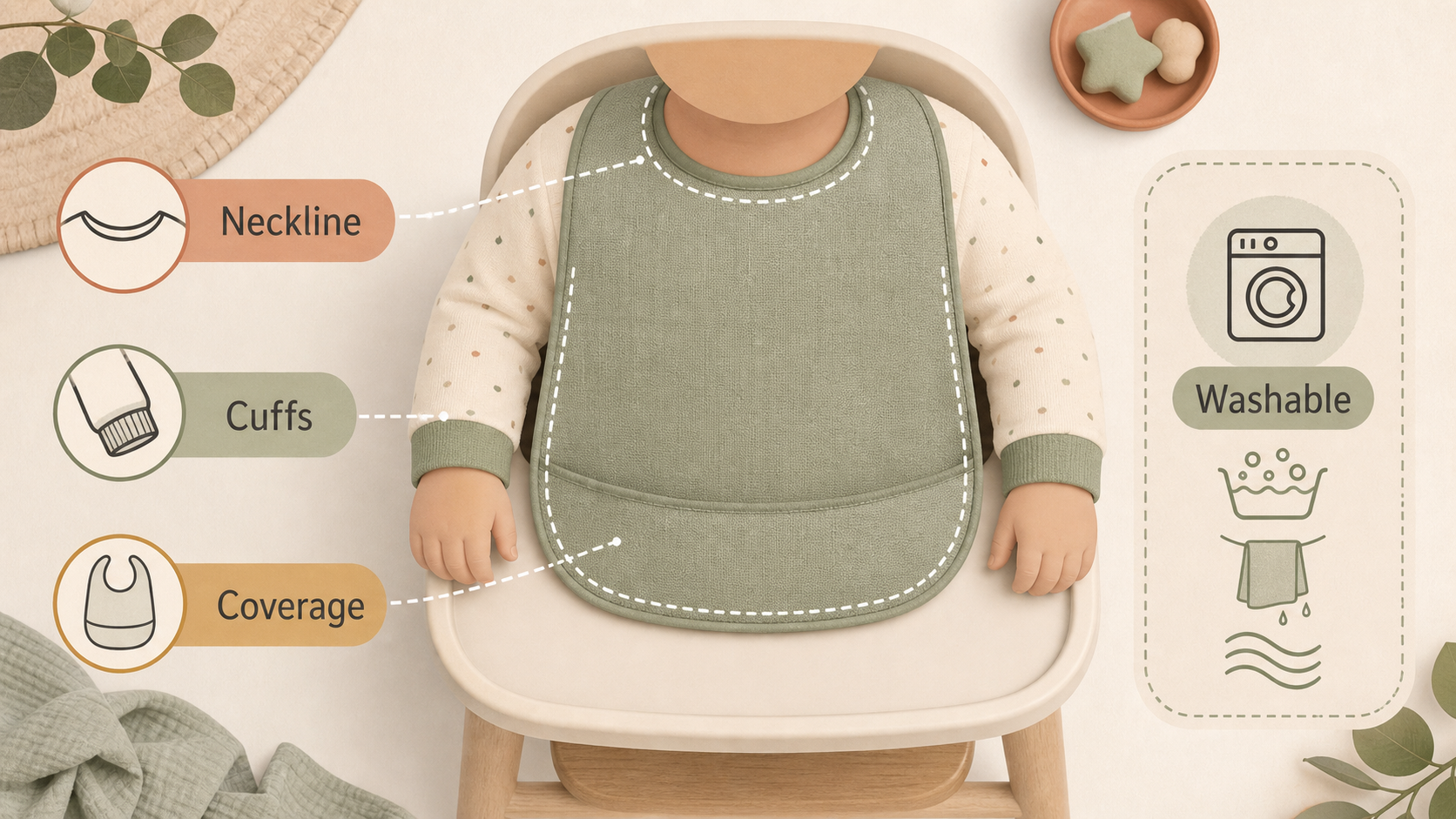 Use the first meal as a low-pressure trial rather than expecting to decide everything from the packaging. Choose a familiar food, fit the bib once your child is seated and keep your usual wipes or cloth nearby. This makes it easier to see how the bib behaves in the circumstances that matter.
Work through four quick checks:
- Fit: Is the neckline comfortable, the fastening secure and the front sitting flat enough for the tray or table?
- Coverage: Did the bib protect the parts of clothing and seating you expected it to protect, without becoming tangled or bunched?
- Movement: Could your child turn, reach, lift food and use their hands without the sleeves, cuffs or torso pulling?
- Care: Was the post-meal wipe, wash and drying routine realistic for your household?
Make a brief note after the meal if you are comparing options. It is often more useful to remember one concrete issue—such as sleeves riding up, food reaching the lap or slow drying—than a general feeling that the bib was good or bad.
For a Bibado Coverall, also compare your observations with the stated age guidance, care instructions and claimed setup compatibility. If the bib does not settle well with your particular chair or child, changing the style or fit approach is more useful than forcing a routine that creates resistance at every meal.
Our [starting solids checklist] can help you place this trial alongside the other practical parts of a first-meal setup.
Frequently Asked Questions
Do baby feeding bibs fit every highchair?
No bib should be assumed to fit every highchair in exactly the same way. Bibado says its Coverall fits a huge range of highchairs, plus most prams and table-ends, but the best check is still your own chair with its tray, straps and usual seating position. Fasten the bib with the child seated and make sure it does not bunch, slip or interfere with the tray.
What age range should I check before choosing a coverall bib?
Check both the manufacturer’s stated range and your child’s actual size. Bibado says its Coverall Weaning Bibs are generally suitable from 6 to 36 months, with fit depending on the child’s size. Assess the neckline, sleeve or cuff room, torso length and freedom to reach once your child is seated.
Can a feeding bib be machine washed and tumble dried?
Care depends on the individual product. Bibado states that its Coverall is machine washable at 40°C and can be tumble dried on low heat. Always check the current care label and instructions on the bib you have, particularly before using a hotter wash or a dryer setting.
What should I do if a feeding bib stains?
Act promptly and follow the manufacturer’s care guidance. Bibado says its Coveralls are stain-resistant rather than stain-proof, and suggests treating stubborn marks with neat dish soap, then a one-off 60°C wash with stain remover and detergent, followed by sunshine drying where possible. Strongly coloured foods may still mark the bib, even when it has protected clothing underneath.
For more comparison help, return to our [baby feeding bibs buying guide].
Sources
Related reading
- Best Baby Feeding Bibs and Mealtime Gear: Evidence-Led Choices for Everyday Messes
- Tommee Tippee Feeding Bib Review: A Practical Buying Assessment
- How to Choose Baby Feeding Bibs and Mealtime Gear for Your Routine
- How to Identify Genuine Baby Feeding Gear Deals
Editorial information: About our editorial team · Read our editorial policy · Read our affiliate disclosure.